
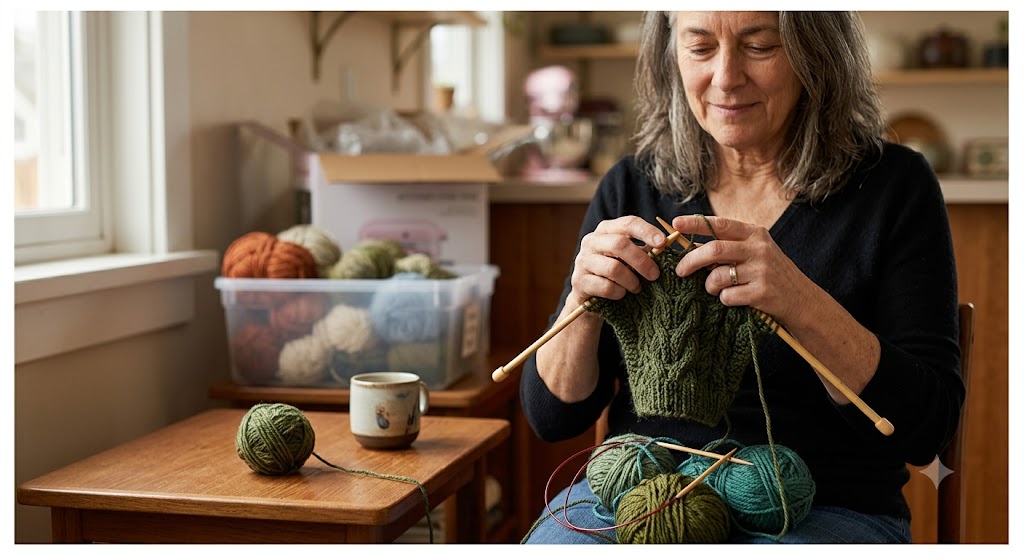
My neighbor Diane bought a four hundred dollar stand mixer during the sourdough phase of 2020, used it maybe eleven times, then gave it to Goodwill and picked up knitting instead. When I asked why, she said kneading dough by hand was the part she actually liked, and the machine had quietly taken that away from her. I think about that conversation more than I probably should, because it’s basically the whole story of what’s happening with hobbies right now, just compressed into one kitchen appliance.
People are backing away from convenience on purpose. Not all convenience, and not everyone, but enough that you can feel it happening if you’re paying attention. Board game cafes are opening in cities where you’d think nobody has time for a three-hour game of Catan. Community garden plots have waiting lists now. My local library added a second book club because the first one got too big for the meeting room. Something shifted, and I don’t think it’s a coincidence that it shifted right around the time everyone’s phone started buzzing forty times a day.
The Scroll Stopped Paying Off
Here’s a thing nobody really argues about anymore: spending three hours moving between email, a group chat, a streaming queue, and whatever app happens to be loudest that day does not feel like rest. It feels like standing in a hallway with too many doors, opening each one for four seconds, and calling that an evening.
Attention researchers have talked about this for years: the way notifications and infinite feeds are built to fragment focus rather than reward it. I’m not going to pretend I fully understand the mechanics behind it, but I know what it feels like on the receiving end, and I’d guess most readers do too. You finish a two-hour scrolling session and can’t actually name anything you looked at.
Slow entertainment, if you want to call it that, works differently. A novel doesn’t compete with itself for your attention the way six open tabs do. A puzzle sitting half finished on a table just waits there, patient, uninterested in whether you come back to it in ten minutes or three days. That patience is the whole appeal, honestly. Nothing about it is trying to hook you.
Board Games Never Actually Left, We Just Forgot to Notice
Card and board games have been sitting in closets since long before anyone had a smartphone to compete with them, and I think it’s worth saying plainly: they never really went anywhere. What’s changed is how loud everything else got around them.
Sit down for a real board game session, and you’ll notice something a screen can’t fake. People argue about rules. Someone misremembers how a card works and gets corrected, loudly, by a sibling who’s been playing this exact game since 2004. Strategies get whispered across the table, alliances form and collapse over the course of ninety minutes, and somebody always ends up laughing too hard at a bad roll. None of that is scripted. None of it repeats the same way twice.
Modern tabletop design has done something interesting here too. Games like Wingspan and Catan pulled in a younger crowd that grew up on video games and didn’t necessarily expect to enjoy sitting at a physical table for two hours. A lot of them did anyway. Board game cafes have popped up in cities that wouldn’t have supported one a decade back, and that’s not nostalgia driving it. It’s people discovering, sometimes for the first time as adults, that a game doesn’t need a loading screen to be fun.
Gardening Runs on a Clock Nobody Controls
Gardening might be the purest example of everything this trend is actually about. You cannot rush a tomato. You can water it, feed it, talk to it if that’s your thing, but the plant grows on its own schedule, and there is nothing your phone can do to speed that up.
That forced patience turns out to be the point, not an inconvenience. Seeds take time. Weather doesn’t care about your plans. A garden teaches you to show up consistently for something that won’t reward you for weeks, sometimes months, and I think that’s a skill a lot of us have quietly lost practice with. It also connects people back to seasons in a way that city life tends to erase. You notice the first frost coming. You start paying attention to when things bloom.
Apartment dwellers have gotten in on this too, just at a smaller scale. A windowsill herb garden isn’t going to feed a family, but it does the same psychological work as a full backyard plot. Something is alive because you kept it alive. That’s a strange kind of satisfaction that doesn’t show up anywhere on a phone.
Reading Long When Everything Else Got Short
Books ask for something almost nothing else asks for anymore, which is sustained attention without a reward every few seconds. That’s a hard sell in 2026, and I say that as someone who still struggles to finish a chapter without checking a notification I don’t even care about.
But readers keep showing up anyway. Independent bookstores that were supposedly dying a decade ago are opening new locations. Library holds lists for popular titles stretch for months. A friend of mine started a romance novel book club mostly as a joke and now has forty people trying to get into a group capped at fifteen.
What reading offers that short content structurally can’t is depth. You spend four hundred pages inside someone else’s head, which does something to your empathy and your vocabulary that a fifteen-second video simply isn’t built to replicate. I don’t think that makes short-form content evil or useless. I just think it does a different job, and people are rediscovering the job that only a book can do.
Getting Outside Without Turning It Into a Production
Walking, cycling, hiking, kayaking, even just sitting outside without your phone, all of it falls under the same idea: move your body somewhere that isn’t indoors, and let the pace be whatever it needs to be that day.
A short walk around the block counts. So does an entire weekend spent on a trail with a full pack. Neither one is more legitimate than the other, which is honestly refreshing in a culture obsessed with optimizing everything into a personal record. Outdoor recreation doesn’t need to be measured to matter. It just needs to happen.
What I’ve noticed, both in myself and in people around me, is that time outside sharpens observation in a way that’s hard to describe until you feel it. You start noticing which trees are changing color first. You clock the neighbor’s new fence, the pothole that finally got fixed, the hawk that’s apparently decided your street is its territory now. None of that shows up if you’re staring at a screen the whole walk.
What Community Activities Actually Fix
A lot of the loneliest people I know are also the most digitally connected people I know, and that contradiction says something worth sitting with.
Volunteering, community gardens, neighborhood cleanup days, amateur sports leagues where nobody’s particularly good- these things work because they force people into the same physical space repeatedly, working toward something that isn’t purely personal. You end up knowing the guy who always shows up late to trail cleanup. You learn which volunteer brings snacks. These are small facts, almost embarrassingly small, but they’re the building blocks of an actual relationship in a way that liking someone’s post never quite manages to be.
Craft workshops do something similar for skills instead of relationships, though usually both happen at once. Someone teaches you to throw a pot or bind a book, and along the way you end up talking to six strangers you’d have never met otherwise.
Why This Actually Helps, Beyond Just Feeling Nice
I’ll admit the wellbeing angle on this topic gets oversold sometimes, dressed up with vague claims that don’t hold up under any real scrutiny. So let me be specific about what I think is actually true here.
Hobbies that involve your hands and your attention at the same time tend to produce a kind of focus that’s hard to get anywhere else, something researchers sometimes call flow. Physical hobbies like gardening or cycling bring movement into a day that would otherwise be entirely seated. Social hobbies build the kind of low-stakes familiarity that turns strangers into acquaintances and acquaintances into something closer to friends. And finishing something- a garden bed, a knitted scarf, a hiking trail you’d been avoiding- gives you a specific, concrete sense of having done something, which scrolling simply cannot offer no matter how many hours you put into it.
I don’t think novelty is actually what people are chasing when they pick these hobbies back up. I think it’s the opposite. There’s comfort in doing the same thing on the same Tuesday every week, in a routine that doesn’t ask you to keep discovering something new just to stay interested.
Technology Isn’t the Villain in This Story
It would be easy to write this whole piece as technology versus tradition, phones bad, gardens good, and call it a day. That’s not actually what’s happening, and I don’t want to pretend otherwise.
A hiking group I know coordinates entirely through a group chat. A woman I met at a pottery class learned her technique from a YouTube channel with maybe eight thousand subscribers. My own reading list mostly comes from an app that recommends books based on what I’ve already finished. None of that undermines the hobby. It just gets people to the hobby faster.
The difference is what the technology is doing. Used as a bridge to get you into a garden, a book, a game night, it’s doing exactly what it should. Used as a replacement for all three, it starts working against you. Most people I’ve talked to about this have figured out that distinction on their own, usually the hard way, usually after a year that felt busier than ever but somehow produced nothing they could point to afterward.
Diane still has her knitting needles out on the coffee table, mid-project, most weeks. The stand mixer’s owner now, last I heard, uses it constantly. Both of them ended up exactly where they wanted to be. That’s really the whole point of any of this: not rejecting convenience, just refusing to let it quietly replace the parts of a hobby that were actually worth doing in the first place.