
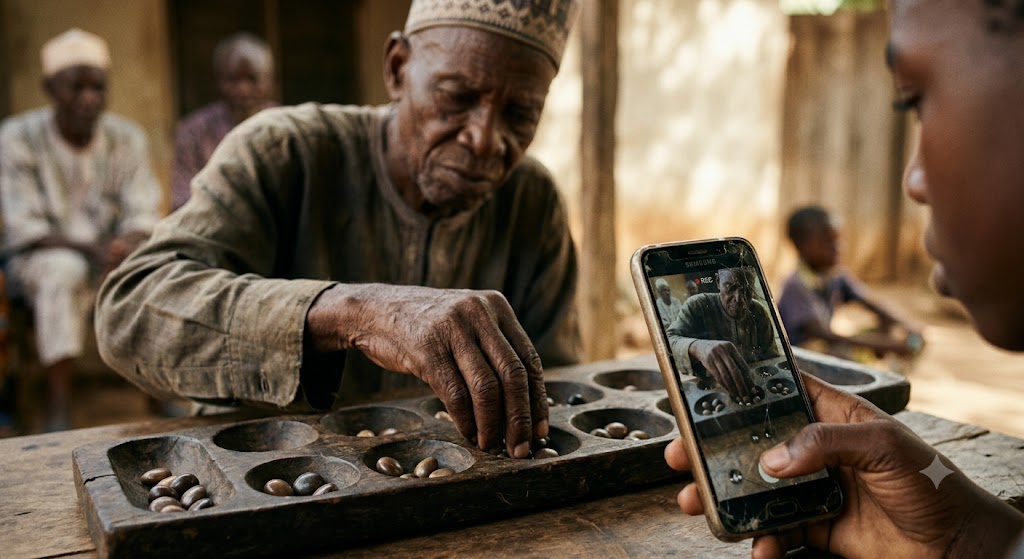
There’s a mancala variant played in parts of West Africa called Ayo, and a few years back I read about a village elder who was, as far as anyone could tell, the last person in his community who remembered the full tournament rule set, the version with the extra capture conditions nobody had bothered writing down. Somebody’s grandson filmed him playing it on a cracked Android phone, mostly just to have footage of his grandfather. That video ended up being the closest thing to a rulebook that variant has. Nobody set out to build an archive. A kid just wanted to remember his grandfather’s hands moving over the board.
I keep coming back to that story because it captures something the preservation conversation usually gets backwards. People talk about technology and tradition like they’re on opposite teams, one racing forward, one trying to hold still. That framing has never made sense to me. The camera in that kid’s pocket didn’t compete with the tradition. It’s the only reason part of it still exists.
Preservation Used to Be a Race Against Time You Usually Lost
For most of history, keeping a tradition alive meant one person teaching another person, in the same room, hoping the transfer stuck. When that chain broke, for any reason- war, migration, a bad flu season, the knowledge just went with it. Museums helped, but only for what could be put in a case. You can’t put a card game’s muscle memory behind glass.
Digital tools changed the math. A high-resolution photograph captures wear patterns on a carved game board that the naked eye would miss in a rushed museum visit. Audio recordings hold onto the exact cadence of a chant or a rule being explained, the pauses and the emphasis, not just the words. Video does even more, because a lot of traditional knowledge lives in movement, not text. Watch someone’s hands shuffle a deck a certain way and you learn something a written rulebook simply cannot teach you.
What strikes me most is the redundancy. A manuscript that used to exist in exactly one place, vulnerable to a single fire or flood, can now sit in a dozen archives at once, on servers scattered across different continents. Losing one copy used to mean losing everything. Now it barely registers as a setback.
Digital Archives Are Doing the Unglamorous Work Nobody Wanted
Libraries and universities have quietly gotten very good at digitizing things before they fall apart, and I don’t think this work gets nearly enough credit because it’s tedious by design. Nobody writes headlines about careful, patient scanning projects.
A typical regional archive might pull together old photographs, newspaper clippings, oral history interviews, handwritten recipe cards, sheet music for songs nobody performs live anymore, and records from community organizations that folded decades ago. Cloud storage means none of it depends on one building staying dry and standing. Search tools mean a researcher can find a specific reference in seconds instead of spending an afternoon flipping through boxes.
What I find genuinely encouraging is who gets to participate now. A small village or an indigenous community that would never have made it onto a national institution’s priority list can run its own digitization project with a decent camera and a laptop. That’s a real shift in who controls the historical record, not just a convenience upgrade. The story of a culture used to be told mostly by whoever had institutional funding. That’s loosening.
Online Communities Turned Documentation Into an Actual Conversation
Here’s something that surprised me when I first started paying attention to this space: a lot of preservation now happens through communities that would never have found each other before the internet existed.
People obsessed with a specific regional strategy game, the kind that maybe three hundred families in one province still play, can now find each other across continents. They swap variant rules. They argue, sometimes genuinely heatedly, about which version is the “correct” one, which is its own kind of preservation because it forces people to articulate details they’d otherwise take for granted. Someone posts a grainy video of their grandmother’s technique, and within a week three strangers from three different countries have chimed in with the version they grew up with.
Traditional card and board games have benefited from this more than almost anything else I’ve watched. A game that used to survive in maybe one town now has a global discussion thread, instructional videos, and occasionally an actual international tournament bracket. That’s not a museum piece. That’s a living thing that happens to have found new oxygen.
Classrooms Got a Tool They Didn’t Expect
Education is where I think this technology quietly does its most durable work, even though it rarely gets the flashy coverage.
A student in a landlocked classroom can now take a virtual walk through a historical site they’ll probably never visit in person. They can zoom into a manuscript at a resolution no in-person viewing would ever allow, since most museums keep fragile documents behind glass and low lighting for good reason. They can hear a language that has maybe a few hundred living speakers left, spoken by someone who learned it from their own grandparents.
Workshops have moved online too, in a way that’s changed who gets access to a skill. Weaving, calligraphy, traditional cooking methods, woodworking, all of it can now be taught by an actual practitioner to a student who lives an ocean away and could never have afforded the travel otherwise. I don’t think this replaces learning a craft in person, sitting next to someone, having them correct your hand position in real time. It gets people close enough to want that in-person experience badly enough to go find it.
Phones Are Doing More Work Than People Give Them Credit For
Smartphones get blamed for a lot of cultural erosion, and sometimes fairly, but I think the preservation side of the ledger gets ignored way too often.
A festival attendee with a phone in their pocket can document a performance in seconds, something that used to require a professional crew with actual equipment. A community group can livestream an event to relatives who moved away decades ago and never expected to see it again. Augmented reality tools let someone stand on a street corner and hold up their phone to see what that exact spot looked like a century earlier, layered right over the current view.
None of this requires special training or expensive gear anymore. That matters more than it sounds like it should. Preservation used to require institutional resources. Now it mostly requires a five-year-old smartphone and somebody who cares enough to hit record.
What’s Actually Happening With Traditional Games Right Now
Traditional games carry more cultural weight than people usually credit them for. They encode strategy, patience, social hierarchy, even humor, in ways that get passed down mostly through direct play rather than through any written source.
That direct chain is exactly what’s been breaking in a lot of places, as families scatter and neighborhoods change shape. Digital tools have stepped into that gap in a few specific ways. Instructional videos preserve rule variants that would otherwise live only in one aging player’s memory. Discussion forums let an experienced player mentor a total beginner on the other side of the planet. Digital adaptations, even clunky ones, work as an on-ramp, introducing people to a game they’d never have encountered any other way.
I want to push back gently on the assumption that a digital version of slot gacor competes with the physical one. In most cases I’ve seen, it’s the opposite. Someone plays a rough app version, gets curious, and then goes looking for the real thing, played with real people, around a real table. The screen version is often just the doorway.
Where AI and 3D Scanning Actually Fit, and Where I’m Skeptical
The next wave of tools is already showing up in this space, and some of it is genuinely useful. Three-dimensional scanning can preserve an archaeological artifact in enough detail that researchers can study it without touching the fragile original.
Virtual reality can reconstruct a historical site that no longer physically exists, letting people walk through something that was demolished or destroyed generations ago.
Artificial intelligence is being used for language documentation and historical transcription, and I’ll admit I have mixed feelings here. It’s genuinely useful for speeding up work that used to take a trained linguist months, transcribing hours of recorded interviews, for instance.
I’m less convinced it should be trusted to make judgment calls about what’s culturally significant enough to preserve. That still needs a human who actually understands what they’re looking at.
As these tools get cheaper, smaller organizations are going to get access to capabilities that used to belong exclusively to major institutions with real budgets.
That’s a good thing. But I don’t think the technology does the meaningful part on its own. It records. It doesn’t decide what matters, and it definitely doesn’t keep a tradition alive by itself.
The Part Technology Still Can’t Do
That kid with the cracked Android phone didn’t preserve Ayo because he understood the historical stakes. He just wanted a video of his grandfather. The archive value came later, almost as an accident.
That’s the piece I keep landing on. Technology is extraordinarily good at capturing and distributing cultural knowledge once someone decides it’s worth capturing.
It cannot decide that on its own, and it can’t replace the actual practice of sitting across from another person and learning something with your hands. The tools have gotten remarkably good.
What still has to happen is entirely human: somebody caring enough to hit record, and somebody else caring enough to watch it, learn from it, and eventually pass it on again.