
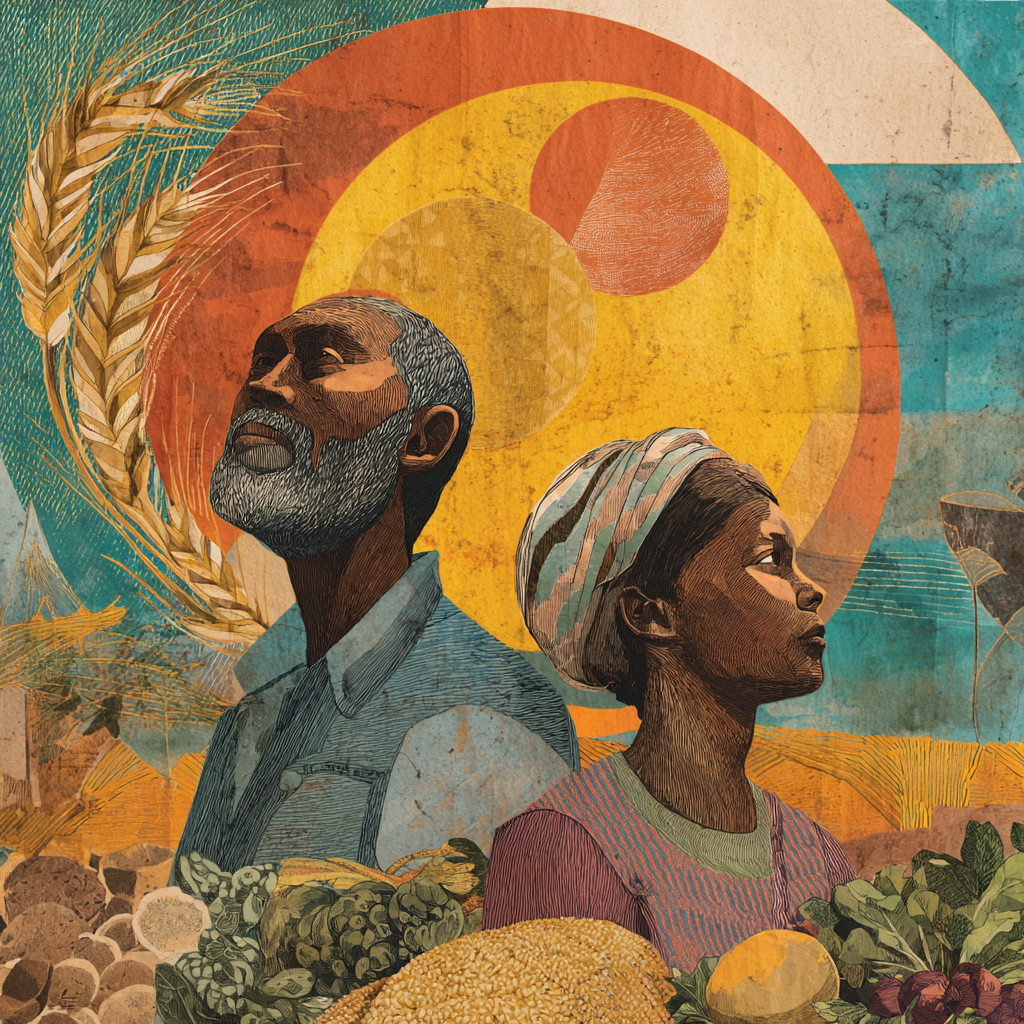
Introduction: A Village That Changed the World
In February 2007, the red-dust flatland of Sélingué, Mali, became the unlikely birthplace of a global declaration.
More than 500 delegates from over 80 countries, peasant farmers, fisher folk, Indigenous peoples, pastorals, women’s groups, and environmental advocates, gathered in hand-built, thatched-roof huts to forge a shared vision for the world’s food future.
They named their forum after Nyéléni, a legendary Malian peasant woman celebrated for her extraordinary farming prowess and her defiance of discriminatory rule.
What emerged from those five days was the Declaration of Nyéléni — a document that gave the global food sovereignty movement its most definitive articulation.
Nearly two decades later, as artificial intelligence reshapes agriculture and 673 million people still go hungry, revisiting that declaration is not an act of nostalgia.
It is an act of urgency.
What Is Food Sovereignty? The Nyéléni Definition
The concept of food sovereignty was first introduced by La Vía Campesina at the 1996 World Food Summit, one year after the establishment of the World Trade Organization, whose trade agreements many activists saw as advancing corporate interests at the expense of rural communities.
The Nyéléni Declaration of 2007 crystallized the concept into a definition that has since been adopted by international bodies, constitutions, and grassroots movements alike:
“Food sovereignty is the right of peoples to healthy and culturally appropriate food produced through ecologically sound and sustainable methods, and their right to define their own food and agriculture systems.”
The declaration also outlined six pillars of food sovereignty, which remain its operational core:
- Focuses on food for people — placing human need, not market demand, at the center of policy.
- Values food providers — respecting the rights and dignity of small-scale farmers, fisher folk, pastoralists, and Indigenous peoples.
- Localizes food systems — bringing producers and consumers closer together and protecting them from corporate dumping.
- Puts control locally — ensuring that land, water, seeds, and biodiversity are governed by those who produce food.
- Builds knowledge and skills — prioritizing traditional and agroecological knowledge over industrial technologies that undermine resilience.
- Works with nature — creating food systems integrated with natural processes and resilient to climate change.
The World in 2007: What the Movement Was Responding To
To understand why Nyéléni mattered, it helps to understand the world the delegates were reacting to. In 2007, the global food system was at a crossroads:
- The WTO’s Agreement on Agriculture was accelerating the liberalization of agricultural markets, exposing smallholder farmers to subsidized imports from wealthy nations.
- The Green Revolution had increased global yields but had not solved hunger — it had instead deepened dependence on chemical inputs and patented seeds controlled by a handful of corporations.
- Land-grabbing in the Global South was accelerating, driven by speculative investment and the early bio-fuel boom.
- The first wave of major agribusiness mergers was underway, consolidating control over seeds, pesticides, and farm machinery.
- Globally, around 850 million people were undernourished — roughly one in eight people on the planet.
The Nyéléni forum was both a diagnosis of these failures and a blueprint for an alternative.
2007 to 2026: What Has Changed — and What Hasn’t
The Hunger Problem Persists
Nearly two decades after Nyéléni, global hunger remains a chronic and growing crisis. According to the 2025 State of Food Security and Nutrition in the World report, jointly published by FAO, IFAD, UNICEF, WFP, and WHO, an estimated 673 million people, 8.2% of the global population, experienced hunger in 2024.
While this represents a modest decline from 695 million in 2022, it still exceeds pre-pandemic levels.
The picture darkens further when food insecurity is measured more broadly: 2.3 billion people experienced moderate or severe food insecurity, and 2.6 billion could not afford a healthy diet.
Based on current trajectories, FAO estimates that chronic hunger will still affect approximately 512 million people by 2030, the very year the world pledged to end it under Sustainable Development Goal 2.
Conflict remains the primary driver of acute hunger.
As of early 2026, the World Food Programme warns that an additional 45 million people could be pushed into acute hunger by mid-2026 due to disruptions from the conflict in the Middle East and energy and fertilizer route disruptions through the Strait of Hormuz.
Corporate Concentration Has Intensified
One of the most alarming changes since 2007 is the acceleration of the corporate consolidation that the Nyéléni forum warned against. A 2025 report by ETC Group and GRAIN paints a stark picture of oligopoly across the agricultural inputs sector:
- Bayer, Corteva, Syngenta, and BASF now control 56% of the global commercial seeds market and 61% of the global pesticides market.
- Four corporations control 62.3% of the global agrochemical market.
- Four key sectors, such as seeds, pesticides, agricultural machinery, and animal pharmaceuticals, now formally meet the definition of an oligopoly (where four firms control more than 40% of a market).
- The agribusiness sector spent over $130 million in lobbying in the United States alone in 2024.
The mega-mergers of the 2015–2020 period, Bayer’s $66 billion acquisition of Monsanto, the $130 billion Dow-DuPont deal, and ChemChina’s $43 billion takeover of Syngenta, fundamentally restructured the sector, placing critical agricultural inputs in fewer and fewer hands.
This concentration is linked directly to food price inflation, as a UN Special Rapporteur on the right to food noted in 2025.
The recent surge in food prices reflects the “high concentration of suppliers’ market power” across the food chain.
Seven Countries Have Enshrined Food Sovereignty in Law
On the legislative front, the Nyéléni movement has scored concrete, if uneven, victories. As of 2020, at least seven countries had integrated food sovereignty principles into their constitutions or national laws, including Ecuador (2008), Bolivia, Mali, Nepal, Senegal, and Egypt (2014 Constitution).
In 2011 and again in 2015, the Nyéléni forum reconvened, first to coordinate resistance to land-grabbing, and again to develop a shared multi-sectoral vision of agroecology.
These gatherings deepened the movement’s political and scientific foundations, establishing agroecology as the primary agri-food alternative to the industrial model.
The New Frontier: Food Sovereignty in the Digital Age
The defining new challenge for food sovereignty since 2007 is not one the Sélingué delegates could fully anticipate the outcome.
The digitalization of agriculture.
And the tension it introduces is both profound and paradoxical.
Digital technologies can empower smallholder farmers, but they can also replicate and deepen the very power structures the food sovereignty movement was built to resist.
The Promise of Digital Agriculture
There is genuine potential in digital tools for small-scale food producers.
Mobile platforms, AI-powered weather forecasting, IoT sensors, and e-commerce systems can:
- Connect smallholders directly to markets, reducing their dependence on exploitative intermediaries.
- Provide real-time pest alerts, agronomic advice, and price transparency.
- Enable blockchain-based supply-chain traceability to help consumers verify where their food is coming from.
- Improve climate resilience through precision agriculture and predictive analytics.
FAO’s 2025 report on food security highlights how digital price monitoring systems are already helping reduce speculation-driven price volatility and improve market access for smallholder farmers.
The agency’s Digital Agriculture and AI Innovation Roadmap, launched in 2025, aims to create a federated, open framework for responsible AI deployment across agrifood systems.
The Risks: A New Form of Extractivism?
Yet critical scholars and farmer organizations raise serious concerns that mirror the warnings of Nyéléni 2007, only now the extractive entity is not just a chemical conglomerate but a platform corporation.
- Data sovereignty is emerging as a core food sovereignty issue. Digital platforms deployed on farms collect massive amounts of data, including soil health, yield patterns, pesticide usage, and canopy volumes, which is then owned by agribusiness corporations, not farmers.
- Algorithmic pricing, according to a 2024 report cited in research published in Discover Agriculture, can favor large farms over small ones, automating disadvantage into the economic system.
- The digital divide is stark: in Sub-Saharan Africa, barely 47% of the population has access to electricity, making the promise of digital agriculture inaccessible to precisely those most in need.
- Corporations like John Deere are integrating AI tools that simultaneously reduce herbicide use and collect proprietary on-farm data, folding digital innovation directly into vertical corporate control chains.
As a 2025 paper in Frontiers in Sustainable Food Systems puts it, rapid digitalization risks eroding traditional knowledge systems, exacerbating inequality among digitally literate elites, and creating new forms of dependency through data extraction.
The danger, in short, is a second enclosure not of land and seeds, but of data and algorithms.
Agroecology as the Bridge
For the food sovereignty movement, agroecology represents the most viable synthesis of traditional knowledge and modern science and a credible alternative to both the industrial model and uncritical digital optimism.
Since the 2015 Nyéléni Forum for Agroecology, the movement has developed a robust definition: agroecology optimizes ecological interactions in food production systems while placing social equity and cultural context at the center.
It does not reject technology, but it demands that technology serve communities rather than extract from them.
Research cited by the Climate Justice Alliance estimates that the global food system accounts for approximately 50% of greenhouse gas emissions, making the transition to agroecological practices essential not only for food sovereignty but for climate survival.
The Unfinished Work: What the Next Decade Demands
As the world marks nearly two decades since the Nyéléni Declaration, the agenda of 2007 is both more relevant and more complex.
The six pillars remain sound; the context has radically shifted. Here is what achieving food sovereignty in the digital age requires:
Policy and Governance
- Regulate corporate concentration: Antitrust enforcement in seeds, pesticides, and food processing must match the scale of consolidation. The ETC Group/GRAIN 2025 report calls for structural remedies to dismantle oligopolies.
- Enshrine data rights for farmers: Any digital agriculture framework must include robust data governance provisions that recognize on-farm data as the intellectual property of the farmer.
- Expand food sovereignty legislation: The seven countries that have constitutionally enshrined food sovereignty should be a floor, not a ceiling.
Technology
- Build farmer-centered digital platforms: Open-source, publicly governed digital tools that transfer benefits to producers, not platforms.
- Fund low-tech and appropriate-tech solutions: Not every farmer needs a satellite-connected sensor; many need reliable mobile connectivity and accessible weather SMS services.
- Integrate agroecological knowledge into AI training data: Ensure that algorithmic models reflect the diversity of farming systems globally, not just the industrial baseline.
Movement Building
- Center women and Indigenous peoples: The Nyéléni Declaration explicitly recognized women and Indigenous communities as the primary custodians of agricultural knowledge. Digital inclusion strategies must do the same.
- Link urban and rural food movements: Food sovereignty is not only a rural agenda. Urban food insecurity and the right to affordable, nutritious food in cities are inseparable from how food is produced.
Conclusion: The Spirit of Nyéléni in 2026
In 2007, a legendary Malian woman who farmed and fed her people well was chosen as the symbol of a global movement. Nearly two decades later, her spirit, patient, grounded, and defiant, is more needed than ever.
The Nyéléni Declaration did not solve hunger.
It did not stop the mega-mergers.
It did not anticipate that data would become the new seed.
But it offered something rarer and more durable, a framework for resistance and reimagination that has grown more sophisticated with every new challenge thrown at it.
The digital age is not the end of food sovereignty.
It is its newest and perhaps most defining test.
The question is not whether technology will transform agriculture; it already has, and it will continue.
The question is whether that transformation will serve the 500 delegates in Sélingué or the boardrooms that were their adversaries.
The answer, as always, depends on who is allowed to define the food system.
From this, we learn how important it is to sustain a good behaviour in producing food and be able to cover the population’s needs while preserving nature and the well-being of the farmers and all those involved in serving food on our table
Frequently Asked Questions (FAQ)
What was the Nyéléni Declaration?
The Nyéléni Declaration was a landmark document adopted in February 2007 at the International Forum on Food Sovereignty in Sélingué, Mali. Signed by 500+ delegates from 80+ countries, it defined food sovereignty and laid out six core principles for people-centered food systems.
What are the six pillars of food sovereignty?
The six pillars focus on: food for people, valuing food providers, localizing food systems, putting local control over resources, building traditional knowledge and skills, and working in harmony with nature.
How many people are still hungry in 2026?
According to the FAO’s 2025 State of Food Security and Nutrition report, approximately 673 million people experienced hunger in 2024, 8.2% of the global population.
The figure remains above pre-pandemic levels.
How does digital agriculture affect food sovereignty?
Digital tools can empower smallholder farmers through better market access and climate information.
However, they also risk creating new forms of corporate control through data extraction, algorithmic pricing that disadvantages small farms, and a digital divide that excludes the most vulnerable producers.
Which countries have enshrined food sovereignty in their constitutions?
As of 2020, at least seven countries have incorporated food sovereignty into law, including Ecuador, Bolivia, Mali, Nepal, Senegal, and Egypt.
Sources: FAO State of Food Security and Nutrition in the World 2025; ETC Group & GRAIN, Top 10 Agribusiness Giants 2025; Nyéléni Declaration 2007 (nyeleni.org); Frontiers in Sustainable Food Systems (2025–2026); World Bank Food Security Update (April 2026); Brown Political Review, May 2025; Discover Agriculture / Springer Nature, June 20