
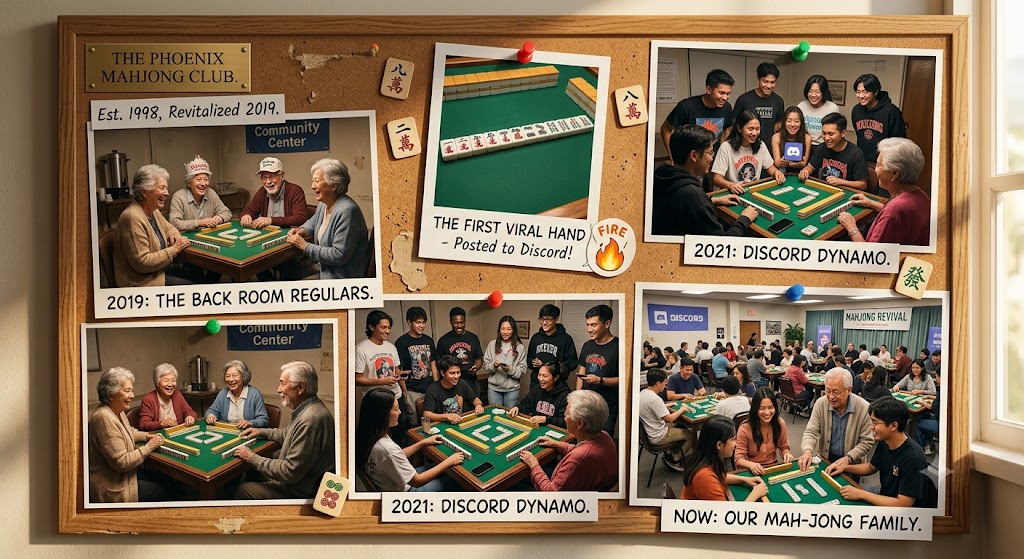
A mahjong club in my area nearly folded in 2019. Four regular members, all over sixty, meeting in the back room of a community center that smelled permanently like old coffee. Then one of them started a small Discord server mostly as a joke, just to post photos of good hands, and within a year the club had triple the membership, most of them under thirty, half of whom had never touched a mahjong tile before finding the server. Nobody planned that. A retiree fooling around with an app her grandson set up ended up doing more for that game’s survival than any preservation grant could have.
That story sits at the center of something I think gets misdiagnosed constantly in coverage of traditional games. The assumption is always that digital culture is what’s killing skill-based, patience-heavy games in favor of faster dopamine. I’ve watched the opposite happen often enough that I don’t buy the doom narrative anymore, or at least not the simple version of it.
These Games Were Never Just About Winning
Strip away the specific rules, and most traditional games- cards, tiles, boards, whatever the local version used- were built to do a handful of things at once. They taught people to wait for the right moment instead of rushing a decision. They rewarded watching an opponent closely enough to notice a habit they didn’t know they had. And they gave neighbors and relatives an actual reason to sit in the same room on a regular basis, which sounds small until you realize how rare that’s become for a lot of adults.
I don’t think the strategic depth is even the main draw for most players, honestly. It’s the conversation that happens around the strategy. Someone misreads a hand, gets teased about it for the next three sessions, and that running joke becomes part of why people keep showing up. A game that only tested skill and offered nothing social would have died out centuries ago regardless of how clever the rules were.
Communities Kept These Games Alive Long Before Anyone Wrote the Rules Down
Nobody preserves a folk game by publishing an official rulebook. That’s backwards from how it actually works. A game survives because a specific group of people keeps playing it, arguing about the edge cases, and teaching it to whoever sits down next.
That’s exactly how these traditions passed along for generations, parent to kid, neighbor to neighbor, usually during a holiday or a slow Sunday afternoon when nobody had anywhere else to be. Every town that played a given card game ended up with its own scoring quirks. Some regions added a bonus round nobody else recognized. Families layered in house rules that had nothing to do with the original design and everything to do with some argument that happened decades earlier and never got resolved.
That messiness is a feature, not a flaw. A rigid, uniform version of a folk game usually means it’s already dead and someone’s just preserving the corpse. The living version keeps mutating.
The Internet Didn’t Kill the Local Club. It Gave It a Waiting List.
People who assumed the internet would finish off traditional games mostly got the mechanism backwards. What actually expanded wasn’t the entertainment options competing for attention. It was the radius a small community could reach.
A player obsessed with a regional strategy game that maybe two hundred families still play seriously used to be stuck hoping a decent opponent lived nearby. Now that same player can find a discussion forum with members on four continents, watch a tournament stream from a country they’ll probably never visit, and get corrected by someone twice their skill level within an hour of posting a question. Geography used to be the limiting factor on how deep a community could go. That constraint mostly evaporated.
Clubs that were quietly dying because they couldn’t attract anyone under fifty have used exactly this kind of digital reach to turn things around, the same way that mahjong club did. Tournaments get organized over group chats now instead of phone trees. Historical variants that would have vanished with the last person who remembered them get recorded on video before that happens.
Archives Nobody Would Have Bothered Building Without a Server Somewhere
A lot of the most valuable preservation work happening right now is genuinely unglamorous, and I mean that as a compliment. Someone sits down and digitizes a decades-old tournament record. A retired player gets interviewed on camera about techniques nobody’s written down anywhere. A regional rulebook that existed as a single water-damaged photocopy gets scanned before it disintegrates entirely.
Museums and libraries do some of this work, but honestly a lot of the best archival material I’ve come across originated from a single obsessive enthusiast with a scanner and too much free time. That’s not a knock. It’s how a huge amount of cultural documentation has always worked, just with better tools now. What used to be locked away in one town’s collective memory can now sit in a searchable archive that outlives every person who contributed to it.
Browsers Quietly Removed the Biggest Barrier of All
Here’s a detail that doesn’t get enough credit in this conversation: a huge chunk of what’s driving renewed interest in traditional games isn’t the games themselves changing. It’s that the technical friction of trying them disappeared.
Ten years ago, exploring an unfamiliar strategy game usually meant downloading dedicated software, sometimes paying for it, sometimes fighting with an installer that didn’t play nice with your operating system. Modern web technology mostly erased that step. HTML5 and responsive design mean a curious player can open a browser tab on a phone, laptop, or tablet and start learning the rules within seconds, no installation, no commitment beyond curiosity.
That matters more than it sounds like it should. Removing friction changes who actually shows up. A teenager who’d never bother downloading a niche strategy app will absolutely click a browser link a friend sent them. Lower the barrier enough and you stop selecting only for people who were already committed before they arrived.
Strategy Still Beats Spectacle for a Certain Kind of Player
Entertainment in general has leaned hard into visual spectacle over the last decade, and I don’t think that’s a bad thing exactly, just a trend that leaves a gap for players who want something else. A meaningful chunk of the audience actively prefers games where the entire experience is decision-making rather than sensory overload.
Skill-based games reward exactly that instinct. Watching an opponent, adjusting a plan mid-session, learning from a loss instead of just replaying the same encounter until you win by attrition- all of that produces a kind of engagement that doesn’t wear thin the way pure spectacle sometimes does. Players who get hooked on this style tend to stay hooked for years, not months, because the improvement curve never really flattens out. There’s always a slightly better version of the strategy to find.
Forums Turned Rivals Into Teachers
The most underrated shift in this whole space, in my opinion, is how online communities changed the emotional texture of learning a traditional game. It used to be intimidating to walk into a room full of strangers who’d been playing for thirty years and ask for help.
Online, that dynamic softened considerably. Beginners post a confused question about a rule interaction and usually get three patient answers within the hour instead of an eye roll. Experienced players record tutorial videos explaining not just the mechanics but the reasoning behind a strategy, which is honestly the harder thing to teach in person. Forums argue endlessly about which regional variant is correct, and that argument itself ends up teaching newcomers nuances they’d never have picked up from a rulebook alone.
Where Digital Adaptations Actually Fit Into This Picture
Digital versions of traditional games don’t replace the physical experience, and I’ve never seen convincing evidence that they try to. What they mostly do is act as a low-pressure preview.
Someone curious about a strategy game can play a digital adaptation a few times before ever sitting across from another human being, which takes a lot of the intimidation out of showing up to an actual table later. Platforms offering games like Bolatangkas show this pattern clearly, blending the convenience of an instant digital session with the same decision-heavy structure that made traditional skill games worth playing in the first place. Nobody walks away from that experience thinking the screen replaced the table. Most people I’ve talked to describe it as the thing that got them curious enough to look for the table in the first place.
Publishers and platform designers have picked up on this too, judging by how many new digital releases lean on clean rule explanations and low-stakes practice modes rather than trying to fully replace an in-person session. The business model increasingly treats the digital layer as an on-ramp, not a destination.
What’s Coming Next, and Where I’d Stay Cautious
A handful of emerging tools are going to keep reshaping this space over the next few years. Artificial intelligence is already being used to generate personalized tutorials that adjust to a specific player’s weaknesses, which is genuinely useful for someone stuck at an intermediate skill level with no local mentor. Cloud infrastructure keeps dropping the cost of running large tournaments, which means smaller regional games can host international events without needing a major sponsor.
I’d push back gently on the assumption that all of this is unambiguously good, though. Automated tutorials can flatten out some of the regional weirdness that made a given variant distinctive in the first place, smoothing everything toward one standardized version because that’s easier to code. That’s a real cost, even if it’s a subtle one. The tools should serve the community’s version of the game, not quietly replace it with whatever’s simplest to build.
The Club Still Meets on Thursdays
That mahjong club I mentioned still meets weekly, last I checked, just in a bigger room now because the old one stopped fitting everyone. The founding members are still there, still needling the newer players about basic mistakes, still running the same house rules nobody’s ever bothered writing down formally.
Nothing about the game changed. What changed was how far the invitation could travel. Technology didn’t rescue this tradition by replacing it with something more convenient. It just made it easier for the people who’d already love this stuff to actually find their way to the table.