
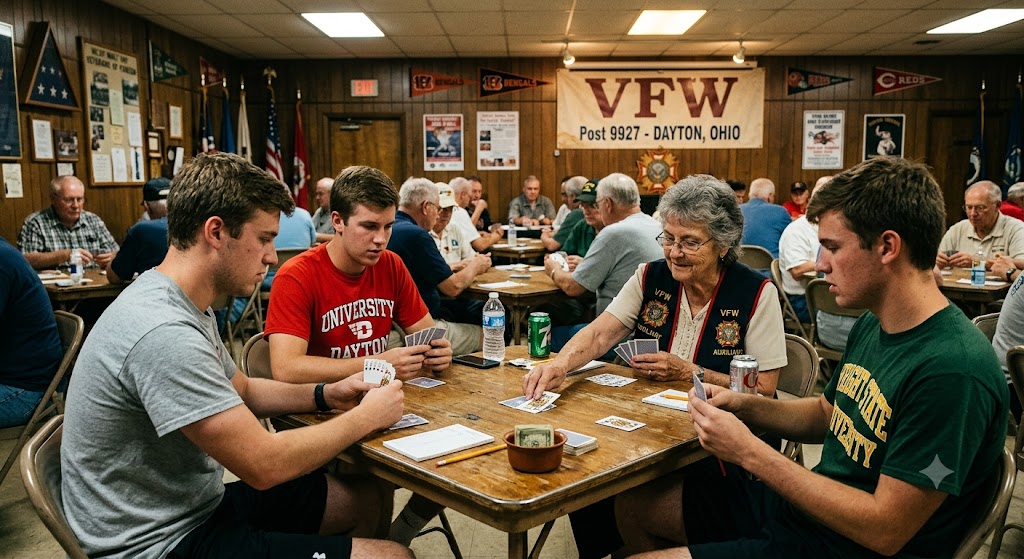
I watched this happen at a VFW hall outside Dayton a couple of summers ago. Four college kids sat down at Edna’s table thinking they’d found the easy match of the tournament. Ninety minutes later they were still trying to figure out how she kept reading their signals before they’d finished making them. She wasn’t lucky. She’d just been playing that specific game, at that specific hall, for something like forty years, and it showed in a way no amount of screen time could fake.
That night is basically why I don’t buy the idea that tabletop games survive purely on nostalgia. Nostalgia doesn’t win you a Euchre tournament against people forty years younger than you. Something else is going on, and I think it’s worth actually naming it instead of waving vaguely at “tradition.”
These Games Have Outlasted Everything Else in the Room
Board games are old in a way that’s genuinely hard to wrap your head around. Archaeologists have pulled game boards out of Egyptian tombs. Roman soldiers carved boards into stone while waiting around on campaign. Chess moved across continents over centuries and picked up local variations everywhere it landed.
What’s interesting isn’t just the age, though. It’s that these games kept mutating without ever fully breaking. Checkers looks different depending on where you grew up. Card games split into hundreds of regional dialects, most of which never got written down anywhere official, just passed hand to hand at kitchen tables. A format that flexible doesn’t survive by accident. It survives because it keeps adjusting to whoever’s playing it.
Compare that to most entertainment tied to a specific piece of technology. A cartridge format dies, and the games on it mostly die with it unless someone bothers to emulate them. A card deck never goes obsolete. You can hand someone a deck from 1950, and they can play with it tonight.
What Actually Happens Around a Table That Doesn’t Happen on a Screen
Here’s something I’ve noticed covering both sides of this industry for a while now: the table does something a lobby screen simply can’t replicate, no matter how good the voice chat gets.
You see someone’s face fall for a quarter second before they play a bad card, and now you know something about their hand that they didn’t mean to tell you. That’s not a mechanic. Nobody coded that. It just happens because humans are bad at hiding things in real time, and a video call compresses too much of that signal away.
Mistakes turn into stories, too, the kind that get repeated at every game night for years afterward. My cousin once trumped his own partner’s ace during a euchre hand, in front of eleven people, and that mistake has outlived at least three of his relationships. Nobody remembers who won that game. Everybody remembers the trump.
Luck and Skill Fight It Out, and That Tension Is the Whole Point
Pure strategy games reward patience in a way that can feel almost meditative if you’re wired for it. Chess doesn’t care how lucky you feel that day. Neither does Go. You get exactly what you put into studying the position.
Card games work differently, and I actually think that difference is underrated. A bad hand in poker or a rough draw in a trick-taking game injects genuine uncertainty into every session, which means a newer player occasionally beats someone who’s been playing for decades. That keeps a table honest. Nobody gets to coast purely on reputation.
Most classic games land somewhere between those two extremes, and I’d argue that middle ground is where the best tabletop design happens. Enough randomness that a bad night doesn’t feel predetermined, enough skill that consistent players still tend to come out ahead over a full season. Settlers of Catan runs on that same tension, incidentally, which partly explains why it broke out of the hobbyist crowd decades after it launched.
Watching a Grandparent Teach a Kid to Cheat, Slightly
Family game nights do something that almost nothing else in a household schedule manages, which is to put three generations at the same table with the same stakes.
My grandfather taught me gin rummy when I was maybe eight, and along with the actual rules he taught me a handful of small, mostly harmless cheats, the kind where you glance at a discard pile a beat too long or count cards just obviously enough that your opponent notices and gets rattled. I didn’t realize until years later that half of what he taught me wasn’t really about the game. It was about reading a room, needling someone politely, knowing when to back off.
Kids pick up genuine skills at these tables without registering it as learning. Counting cards teaches arithmetic nobody frames as homework. Negotiating a trade in Catan teaches persuasion. Losing a close hand and having to shake hands afterward teaches something schools spend entire units trying to instill and usually fail to.
Losing Well Is a Skill You Actually Get to Practice
I don’t think people talk enough about how rare it is, in modern life, to lose at something in front of people who then immediately want to play again with you.
Board and card games hand you that experience on a weekly basis if you let them. You misplay a hand. Someone calls it. You groan, maybe complain a little, and then you shuffle and go again. That’s a specific muscle, handling a small public failure with something like grace, and I genuinely think a lot of people are worse at it than they used to be simply because they get fewer reps.
Regular opponents start to know your tells after enough sessions, which sounds intimidating until you realize it actually builds a strange kind of intimacy. You know how your neighbor plays when he’s bluffing. He knows you always underbid your hand out of habit. That familiarity is its own reward, separate from who actually wins.
Board Game Cafes Aren’t Surviving, They’re Multiplying
A decade ago I’d have guessed board game cafes were a niche curiosity that would fade once the novelty wore off. I was wrong about that, pretty clearly.
These places keep opening in cities that already seemed saturated with entertainment options, and the ones I’ve visited are usually packed on a random Tuesday, not just weekends. Strangers end up at the same table because a cafe seated them together, and somehow that works better than most engineered icebreaker events I’ve sat through professionally. Libraries have gotten in on this too, running family game nights that pull in people who’d never normally set foot in a library on a weeknight.
Local clubs run tournaments that mix total beginners with players who’ve been competing for twenty years, and from what I’ve seen, the culture around most of these clubs leans toward teaching rather than gatekeeping. Chess clubs in particular have gotten good at this. Someone loses their first ten games in a row and still comes back, because the losses came with actual coaching attached.
Digital Tools Feed the Table, They Don’t Replace It
I used to assume apps and online play would eventually hollow out physical board gaming. That hasn’t happened, and I think I understand why now.
A mobile app teaching someone the rules of a strategy game functions like a practice court before a real match. You learn the mechanics without embarrassing yourself in front of people you’ll see again next week. Online forums let enthusiasts argue about house rules across countries that would never otherwise cross paths. Video tutorials explain a complicated rulebook faster than most printed instructions manage, honestly, and I say that as someone who still prefers reading the booklet.
What I keep seeing is people using the digital version as a doorway into the physical one, not a replacement for it. Someone learns a strategy game on their phone during a commute, gets hooked, and eventually shows up at a local club wanting the real table experience. Publishers have noticed this pattern too. A lot of new editions now ship with better components and clearer rulebooks specifically because the digital version already did the job of getting people curious.
The Slowness Is Not a Bug
Modern entertainment is engineered to move fast. Feeds autoplay into the next thing before you’ve processed the last one. Notifications interrupt whatever you were actually doing.
A decent board game session runs the opposite direction on purpose. You sit with a decision for a minute, sometimes longer, and nobody’s rushing you toward the next dopamine hit. Sessions run an hour, sometimes three, and the people at the table generally aren’t checking their phones, mostly because there’s nothing to check when you’re mid-hand and your partner’s staring you down.
I think that deliberate pace is exactly why tabletop gaming keeps pulling in people who spend the rest of their day moving as fast as possible. It’s the one part of their week that refuses to hurry.
Edna’s Still Playing
Edna’s back at that VFW hall most Thursdays, from what I hear, still finding new twenty-somethings to dismantle at Euchre. The game hasn’t changed much since she learned it. The players around her keep changing, generation after generation, each one convinced they’ve got the edge this time.
That’s really the whole story here. Board and card games survive because they’re built around a table, not a screen, and a table doesn’t care what decade it is. It just needs people willing to sit down, pay attention to each other, and play.